

Every marketer wants to capture audience attention without wasting any of their precious time and budget. This is where the 3-3-3 rule in marketing comes into play. The 3-3-3 rule is a framework that assists the audience in every facet of their buying journey, helps in creating focused messages, and shows how to strategically distribute content.
It somehow helps a firm to grab what the target audience is truly searching for, satisfy them, and build trust accordingly. It does not matter whether you are owning a small business or a new startup founder; this rule will definitely give you a breakthrough to perform better.
In this Innocams blog, we will show you the 3 pillars of the 3-3-3 rule of Marketing, when the 3-3-3 rule doesn’t work, common mistakes to avoid, and the whereabouts of implementing the rule. Are you ready to dive into it for better results? Let’s get onboarded.
Table of Contents
Why the 3-3-3 Rule in Marketing is necessary
Are you determined to amplify your marketing strategy and streamline it for reaching the target audience? Sometimes marketing becomes an overwhelming journey that frustrates you due to a plethora of platforms and endless tools at your disposal. Honing a strategic and impactful marketing strategy, from engaging to trust-building, would become a difficult task deter you from reaching the target audience.
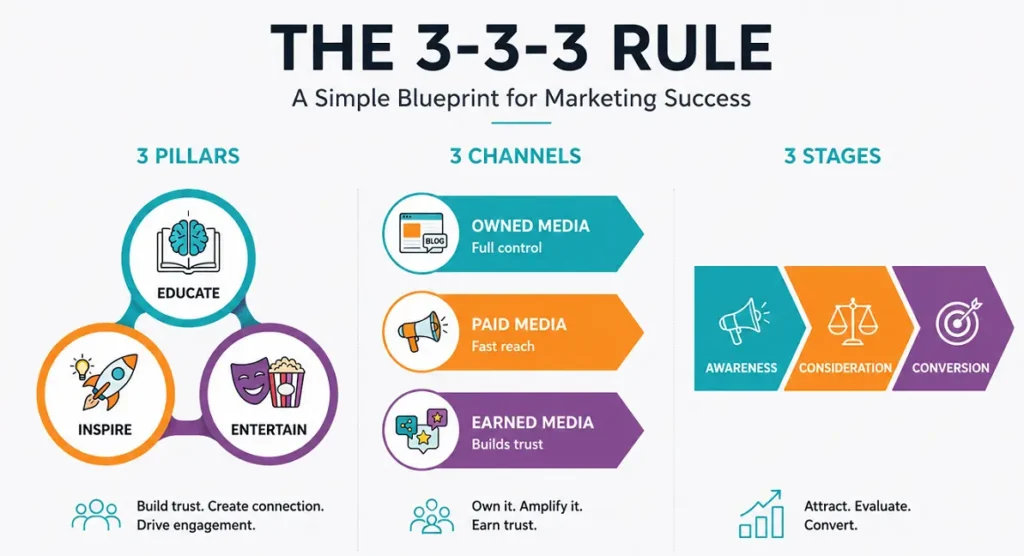
This is exactly why the 3-3-3 Rule steps forward as a solution to audience engagement, trust-building, and ultimately converting them to a viable growth ladder. 3-3-3 Rule in marketing is a powerful framework that sheds light on how three messages help to reach the services or brand, how to target the niche audience segment, followed by the navigation to keep prioritizing the audience based on three marketing channels.
Balance and focus play an invaluable role in making the marketing campaign manageable and well aligned without any information overload. Let’s picture a situation by yourself. Suppose a marketing campaign led by a fitness brand is trying to consolidate the brand message to the target group through its build-up quality, trust, and affordability. How does it actualize?
This message sharing would be easier if it is aligned with marketing platforms like email, social media, and search engines. The competence to reinforce the repetition of message sharing ensures better engagement, customer recall, and loyalty build-up.
3 Pillars Of The 3-3-3 Rule Of Marketing
Audience engagement is an art, and knowing how to gain mastery of the art gives you an edge to serve the purpose of marketing. Let’s have a look at the three essential pillars of the 3-3-3 rule of marketing enshrined below.
Content Strategy
3-3-3 rule emphasized three types of content: educational content, entertaining content, and inspirational content.
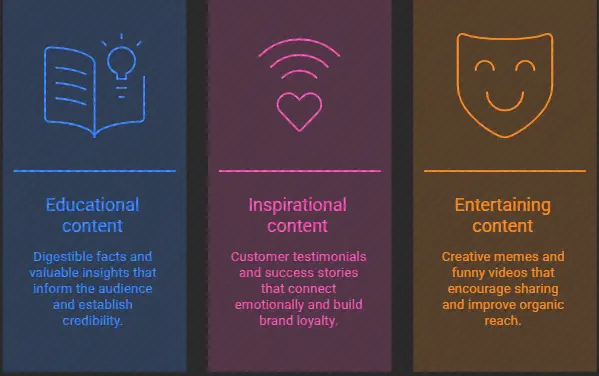
Educational Content: Millions of users every day go online to discover a plethora of information for their educational content needs. Readers are looking for digestible facts and something that answers their pain points. Simply put, making educational content informs the audience about the idea of their content strategy to reach the target group.
This content strategy aims to establish rapport with customers by giving them valuable insight to establish credibility and trust. According to The New York Times licensing, 40% of buyers are parsing through a figure of 3 to 5 pieces of content before thinking of opting for a salesperson. This is why digitization has made educational content increasingly significant.
Creating informative & people-first educational content expedites search visibility and helps to secure your organic visibility on search engine results pages (SERP). Suppose you have a digital marketing firm and you are determined to build a rapport to showcase your brand as an established authority. How does it actualize?
eBooks, webinars, blog articles, guides, and tutorials posted on your site help you to gain an edge because it is informative and people-first, devoid of unnecessary clutter.
Inspirational Content: Knowing how to connect the audience emotionally acts as a beacon to strengthen the connection and uplift your content for better reach. Customer testimonials, success stories, and messages help you to ignite inspiration among the target audience and strengthen the brand value.
Inspirational content can establish rapport and build an emotional chord with viewers to acquire substantial viewership. Promotional content is everywhere. This is why inspirational content is breaking the clutter and making content that is more meaningful and worthy. People love sharing inspirational content, and that high sharing potential helps to establish trust and loyalty. Success stories, testimonials, and motivational content are helping to transform a simple vendor into something meaningful for the customer journey.
Entertaining Content: Adding creativity and humor to the content acts as a catalyst that encourages sharing among social groups and assists in improving organic reach by positive word of mouth. Memes, funny videos, coupled with social media posts, come under entertaining content that is shareable among social groups. When the audience engages with entertaining content, it results in greater reward and more visibility.
Content Distribution
The distribution of content is guided by three important channels that include: paid media, earned media, and owned media.
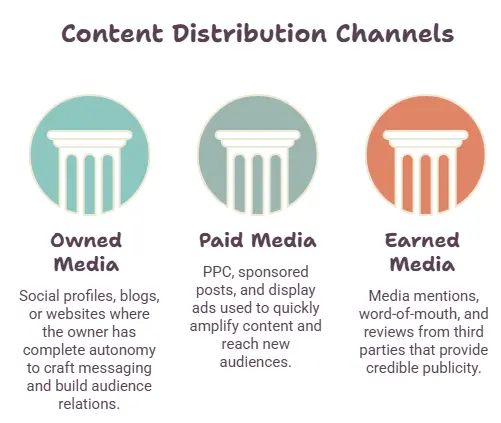
- Owned Media: The control and autonomy of a site when left to the owner himself; that is the media owned. Let’s simplify this for you. Supposedly you have a social profile, blog site, or websites. Now what’s the catch behind it? The owner has complete autonomy to make the messaging, and it meanwhile acts as an instrument to build lasting relations with the intended audience base.
- Paid Media: If someone intends to quickly reach the target audience base for more traffic and better reach, paid ads act as an instrument to ensure content amplification and new audience reach. PPC, sponsored posts, followed by display ads, come under the paid media category for the content distribution process.
- Earned Media: Some content distribution processes are facilitated by third parties by dint of media mentions, word-of-mouth and reviews that help to earn positive publicity. They are generally more credible as it comes from a third party.
Let’s check the table below to know why they are needed
| Channel | Key Benefit | Why Needed in Marketing |
| Owned Media | Full control & autonomy (websites, blogs, social profiles) | Builds long-term audience relationships and consistent brand messaging |
| Paid Media | Fast reach & amplification (PPC, sponsored posts, display ads) | Quickly drives traffic, boosts visibility, and acquires new audiences |
| Earned Media | Third-party credibility (mentions, reviews, word-of-mouth) | Generates trust and authentic publicity that paid efforts can’t easily replicate |
Audience Engagement
Knowing the stages to channelize audience engagement helps to guide them and pave the backdrop for raising the chances for ultimate conversion.
- Awareness: In the awareness stage, the brand needs to educate the target group about their pain points and make them realize that the service or product meets the burgeoning demand of the necessity they are intended for. In the awareness phase, making educational content that is informative and people-first with presentable infographics meets the need.
- Consideration: At this stage, the prospect makes a comparison listing to know the review and solution for every nitty-gritty of the content. Case study, product demo, and expert insight help to gauge in-depth content comparison to know their potential strengths and drawbacks.
- Acquisition: When prospects are fixed in their mind to go for the purchase, then to speed up their decision-making, they are given free trials, discounts, and incentives. The stage helps to make the audience feel more confident in pursuit of their purchase intent.
Common Mistakes to Avoid
Many marketers are unable to catch the exact point of the 3-3-3 rule in marketing, and their misunderstanding of how to hone the actual rule makes them compelled to make some mistakes. Let’s have a look at some mistakes often made and their quicker fix suggestions.
| Mistake | Why It Hurts Results | Quick Fix Suggestion |
| Too much posting of promotional content | A shifting trend toward sales pitches is inevitable, leading to audience fatigue and lower engagement | Prioritize value first |
| Ignoring audience feedback | Ignoring the feedback of the audience acts as a deterrent, leading to irrelevant information full of clutter and gibberish | To mitigate the issue, review comments regularly and address them before they escalate further |
| Thin content lacking content depth | In terms of trust or authority build-up, thin content lacking content depth hurts the outcome | Adding real insights and examples builds credibility; avoid surface-level tips that seem unnecessary |
| Unclear messaging | The readers feel confused, which weakens brand recall | The post must have a clear takeaway followed by a definite call-to-action |
How to implement the 3-3-3 Rule in marketing
Knowing each step gives you a guide to implement the 3-3-3 Rule in marketing judiciously.
| Step | Key Action taken | Notes to consider |
| 1. Balance Content Mix | Create 3 content types | Educational + Inspirational + Entertaining |
| 2. Diversify Distribution | Use 3 media types | Owned + Earned + Paid channels |
| 3. Align with Buyer’s Journey | Target 3 stages | Awareness → Consideration → Acquisition |
| 4. Measure & Optimize | Track & refine | Monitor performance across all 3 components and adjust |
Final words
In marketing, the 3-3-3 rule is not just a rigid formula but somehow appears as a practical framework helping businesses to bring forth simplifying their marketing efforts while boosting audience engagement. The framework acts as a beacon at every stage of the buying journey, enabling brands to build trust rather than merely chase surface-level impressions.
Nevertheless, this framework works best when it is perfectly aligned with audience research, quality content framing, and regular performance analysis.
Frequently asked questions (FAQs)
What is the 3-3-3 rule in marketing?
In marketing, the 3-3-3 rule is a strategically curated framework that focuses on three specific elements without leading to any resource burnout. The 3-3-3 rule aims to share three core messages across three content distribution channels and make a reinforcement for it accordingly for better recall.
Does the 3-3-3 rule work for small businesses?
Yes, the 3-3-3 rule works well for small businesses too. It allows the boost of engagement and ensure a boost of brand recall without any resource burnout.
Can the 3-3-3 rule improve SEO?
The creation of a content framework and a strategically designed message led by the 3-3-3 rule acts as a beacon that indirectly influences SEO, driven by higher engagement of user coupled with better recall for the brand.
Is the 3-3-3 rule suitable for social media marketing?
For social media marketing, the 3-3-3 rule is a suitable platform that ensures better reach of customers and better distribution of the content through audience engagement.
