

Starting a B2B content marketing journey is not a sprint; it’s a marathon that demands resilience and commitment to build trust with others. Unlike consumer shopping or B2C marketing, B2B marketing demands an allure for selling products to a team of managers and buyers. Kickstarting a B2B content marketing seems intimidating, as it provides return on investment (ROI) after a period of time, not as quickly as B2C does.
If you think it’s a sprint, you would probably bury your content under the grave, and you won’t enjoy the growth over time. Most B2B content marketing endeavours eventually face futility because they skip the valuable stepwise strategy and jump to publishing. Go through the 6-step framework mentioned in the article to dig out the necessary idea to start B2B content Marketing.
| Are you determined to start your B2B content marketing journey with determination, but somehow feel a bit intimidated to initiate it? Follow the 6-step framework to start effectively your B2B content marketing 1. Define Your Audience and Buyer Personas 2. Set Clear, Measurable Content Marketing Goals 3. Conduct Keyword and Topic Research 4. Build Your Content Strategy 5. Create High-Quality, E-E-A-T Aligned Content 6. Distribute, Promote, and Repurpose Your Content |
Table of Contents
What Is B2B Content Marketing?
B2B content marketing is a process for content creation and distribution across the marketing funnel, aiming to capture the attention of other businesses. It is the gateway that influences the way you educate and convert your business buyers to influence their decision process, led by high-quality, engaging content.
B2B buyers don’t come up with a conclusion for their buyer’s choice quicker rather compare options and tally them until they feel confident to go for it. It’s not actually the struggle over content creation, but the way it leads to connecting them with buyers.
B2C marketing leverages the marketing channels to reach the customers directly, which are generally quick and emotion-driven. Unlike single consumer shopping noticeably seen with B2C marketing, B2B marketing demands more technicality with in-depth analysis & effort-intensive commitment to allure a team of managers and buyers for selling products. In B2B, trust building and authority gain demand time to convert them into qualified leads, while B2C promises quick sales with impulse-driven purchases.
B2B vs. B2C Content Marketing: Key Differences
B2B marketing sheds light on selling to businesses, which often involves perpetuation through longer sales cycles & multiple stakeholders to deliver ROI-driven messaging. Unlike B2B marketing, B2C involves quickly alluring target customers to drive emotional purchases. Let’s keep a close eye on the key differences between B2B vs. B2C Content Marketing in the table below.
| Factors worth considering | B2B Content Marketing | B2C Content Marketing |
| Audience | Smaller groups & buying committees (multiple decision-makers) | Broad individual consumers |
| Sales Cycle | Longer, research-heavy & complex | Shorter, often emotional/impulse |
| Content Style | In-depth, educational, technical & data-driven (e.g. guides, webinars) | Entertaining, visual & emotional (e.g. videos, stories) |
| Goal | Build trust, generate qualified leads & authority | Drive brand awareness, engagement & quick sales |
| Tone & Focus | Professional, solution-oriented for business pain points | Fun, relatable & lifestyle-focused |
| Channels | LinkedIn, email nurturing, detailed SEO | Social (Instagram/TikTok), mobile-first, broad SEO |
Step 1 — Define Your Audience and Buyer Personas
Analyzing the audience is the cornerstone of a successful B2B content marketing endeavour. If you don’t have enough idea of exactly why you are doing your marketing or exactly who your target audience is, how would you expect them to discover you? Knowing buyer expectations and knowing the exact way to navigate their needs helps you reframe and personalize the strategy of B2B content marketing. You need to keep learning every day about the buyers. Always remember customer persona should never be static. To make you easily learn about the buyers every day, one thing you must not ignore is the SEO research.
Keeping yourself well-versed with the search intent is invaluable, and SEO keyword research helps you to know what exactly people are searching for or about the keyword that has the potential to rank. Unlike B2C marketing, which has a linear pathway for knowing the buyers, the B2B pathway to know buyers is meandering and involves multiple people to weigh up multiple options for consideration.
Making a detailed buyer persona helps you to know whether the messaging or your content meets their expectations or not. Before proceeding further, ask yourself whether your product or service solves the actual pain point of your B2B buyers who are truly looking for? This is why knowing your audience and buyer personas is an unignorable facet for B2B content marketing.
Step 2 — Set Clear, Measurable Content Marketing Goals
If you don’t have a clear idea of what exactly to start from or exactly where you want to go over a period of time, you will never attain success. This is why, for B2B content marketing, setting clear and measurable goals is indispensable. Supposedly, you have taken an oath to make a connection to your content goals and business objectives.
At first, you are aiming to increase organic traffic by 30% in the next 12 months as your awareness goals. Now you have opted for generating 25 to 35 marketing-qualified leads (MQLs) from content per month by the end of Q4 as your lead goals for B2B content.
Setting your revenue goal to attribute 30% of the pipeline to B2B content by year-end is also measurable and realistic. Setting highly measurable goals helps to transform your marketing goals into sales success over time. This would help you to stay focused and help you fulfill your broader business objectives.
Step 3 — Conduct Keyword and Topic Research
Conducting Keyword and topic research helps to navigate the exact customers’ pain points or the “why” behind their rationale to choose something as a buyer they are intended for. Using keyword research tools like Semrush & Ahrefs is invaluable for keyword research, helping to identify or gauge the following for keyword and topic Research mentioned below with justification.
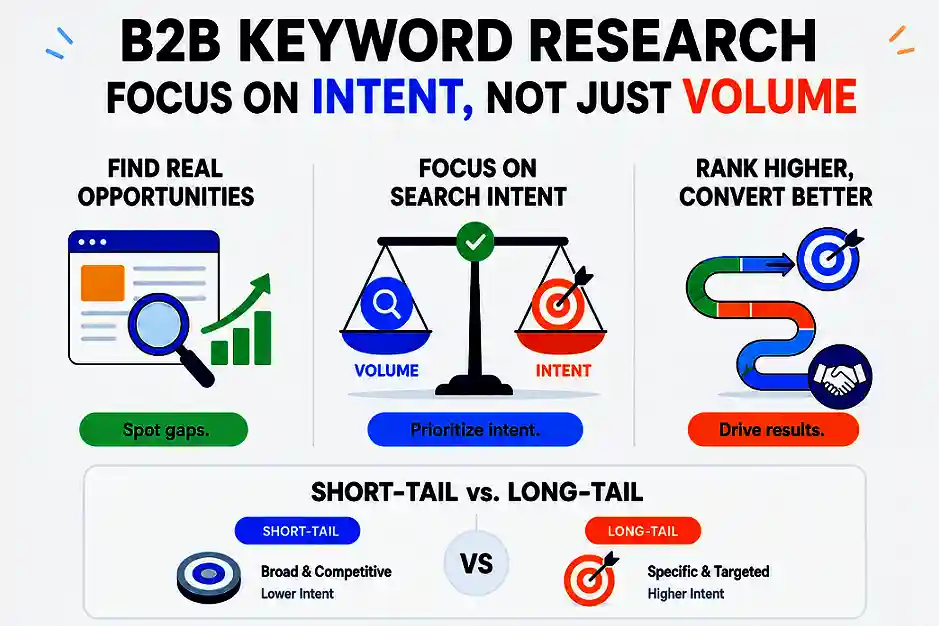
High-intent keywords your buyers search: Semrush and Ahrefs are excellent SEO tools that would help to navigate the process of finding high-intent keywords buyers are actually looking for. Semrush has a tool called Keyword Magic that would help you discover suggestions for highly relevant keywords. It comes up with actual data, AI, and advanced filters to deliver the opportunities for the best keywords to translate them into organic growth.
Questions your buyers ask (People Also Ask): To discover what the customers are exactly looking for, both the tools Semrush & Ahrefs assist in knowing “People Also Ask” (PAA) Questions.
Gaps in competitor content you can own: Semrush & Ahrefs help to comprehend competitor content gaps. Meanwhile, they are helpful tools to give you an insight into lists of keywords and topics that the rivals rank for, but you are lagging behind them in doing so, revealing exactly where you need to focus for content creation to steal their traffic.
Long-tail keywords with ranking potential: Instead of short-tail keywords, keep emphasizing long-tail keywords as it usually delivers higher conversion despite having less search traffic. They usually contain longer keyphrases that propel users to search for them as they meet the specific search intent they are actively looking for. Instead of “Wedding supplies”, searching for the longer keyphrase “Matching bridesmaid dresses for wedding event planners” tends to be more specific as per buyers’ search intent in B2B.
Intent surpasses the volume in B2B. Long-tail keywords put forward the highest-quality traffic because they are credible and competent to know the mechanism of making a mirror of how real buyers evaluate solutions.
Step 4 — Build Your Content Strategy
The content strategy needs to be framed properly to keep the audience engaged with the content at distinct stages. Each content type serves a unique purpose as per the user intent.
The types of content may include whitepapers, webinars, case studies, and blog posts.
A content strategy that is deliberately planned not only helps with lead generation but also guides the target group to make decisions. Delivering valuable content is the success gateway for your B2B, helping to come out as an industry leader with trusted resources. Let’s see different stages of the content funnel, types of content, purpose, and why they are worth considering for B2B.
Different stages of the content funnel and why they are worth considering
| Funnel Stage | Content Types | Purpose / Role | Why It Is Important |
| TOFU (Top of Funnel) | Blog posts, infographics, videos, social media content | Generate awareness and attract new visitors to your site | Builds brand visibility, drives initial traffic, and grows your audience pool |
| MOFU (Middle of Funnel) | Whitepapers, case studies, ebooks, webinars, comparison guides | Nurture leads by providing in-depth information and addressing buyer concerns | Educates prospects, builds trust and authority, and qualifies leads |
| BOFU (Bottom of Funnel) | Product demos, customer testimonials, free trials, pricing pages, case studies with ROI data | Convert leads into paying customers | Directly influences purchase decisions, provides social proof, and closes sales |
Step 5 — Create High-Quality, E-E-A-T Aligned Content
For B2B content marketing, it is important to keep a prior emphasis on the creation of high-quality, E-E-A-T Aligned Content. Writing content with generic fluff is not wise, as it hurts both SEO and visibility, as it is unable to match user intent; hence, it is important to keep focus on making content that would prove helpful and benefit people.
E-E-A-T is an acronym for “Experience”, “Expertise”, “Authoritativeness”, and “Trustworthiness,” the four qualities that signal to decide which content is worth enough or deserving to rank and which do not. Google judges content based on the 4 pillars, and making high-quality content means the user’s expectations are fulfilled and good enough to rank higher on the SERP.
Step 6 — Distribute, Promote, and Repurpose Your Content
After making the high-quality content, what comes next? It is nothing but a process to distribute, promote, and repurpose the B2B Content to ensure the maximum ROI from the content. Now you think what is content marketing ROI, right? Let’s have a look at the formula showing Content Marketing ROI % = ([Return – Investment] / Investment) x 100. It is showing the difference in return and total investment value divided by the investment, expressed as a percentage. Content distribution is the process of delivering the content to the right people when they actually need it.
After the content distribution, it comes to content promotion, which is done by whitepapers, webinars, and case studies, aiming to generate leads and acquire brand trust. LinkedIn Advertising, account-based marketing, and email marketing are the channels to perform the task. Next comes content recycling, also known as repurposing content to reach a wider audience.
How to Measure B2B Content Marketing Success
Now the question definitely comes across your mind: how to measure B2B Content marketing success or ROI is not so? Some metrics help to navigate the marketing ROI for B2B as a survival skill. Knowing them helps you surpass the actual return over the marketing cost incurred upon it. I had already discussed the metrics for measuring B2B Content Marketing success on innocams.io titled “How To Measure B2B Content Marketing ROI – All You Need To Know”. Read the article to know it in detail.
H2: Common B2B Content Marketing Mistakes to Avoid
Some mistakes kill the B2B content ranking and are detrimental to the marketing pipeline. Let’s have a look at the B2B content marketing mistakes to avoid and ways to fix them, as mentioned in the table below.
| Mistakes to avoid for B2B content | Mitigation tactics or ways to fix |
| Creating Content Without a Documented Strategy | Making a clear content strategy with documentation to outline goals, target audience, and success metrics is invaluable before proceeding to create any content. |
| Prioritizing Quantity Over Quality | Keep the entire focus on making high-quality, audience-intent-driven content instead of churning out frequent, thin articles with fluff. |
| Talking About Your Product Instead of Buyer Problems | Knowing buyer pain points and providing solutions first (80/20 rule). It is important to position your product to meet the buyer’s problem and give exactly what they are looking for |
| Ignoring Distribution | A multi-channel distribution plan (owned, earned, and paid) helps to amplify reach beyond just hitting the “publish” button for B2B content. |
| Creating Only TOFU Content | Give equal attention to full-funnel content strategy with MOFU (comparison/evaluation) and BOFU (case studies, demos, ROI proof) content. |
| Not Updating Existing Content | It is an undeniable necessity to never overlook the audit and refresh of the high-performing older content every 6–12 months to maintain rankings. |
Conclusion
Initiating a journey with B2B content marketing isn’t just the prodigal publication of content; rather, it emphasizes reaching the right content for the right audience during the buyer’s journey. Meanwhile, the success of B2B content is dependent upon setting measurable goals, staying involved in keyword research, building a content plan, creating E-E-A-T-focused quality content, and promoting it effectively to guarantee the earning of qualified leads and establish long-term authority within your industry.
B2B buyers rarely make instant purchasing decisions. They keep themselves engaged in evaluating multiple options, comparing solutions, and keeping their bird’s-eye view on seeking trustworthy information before taking any action.
FAQs
What is the goal of B2B content marketing?
B2B content marketing is envisioned to educate and convert business buyers into qualified leads by influencing their decision process, led by high-quality, engaging content.
How long does B2B content marketing take to show results?
B2B content marketing requires a timeframe of 3-6 months for acquiring initial traffic gain & measurable results, while ranking improvement demands 6-12 months of consistency in publishing content to attract leads.
What content types work best for B2B?
Educational in-depth content that provides information through case studies, webinars, whitepapers, and also sheds light on how-to guides works is best for B2B marketing.
Is B2B content marketing worth it for small businesses?
If any small businesses are struck with budgetary constraints and are unable to bear a massive advertising budget, the potential to generate ROI makes B2B content marketing worthwhile for these types of businesses.
