

Investing in content marketing brings fortune for B2B companies, helping them to generate 3x more leads than those dependent on traditional outbound methods at a considerable 62% lower cost. Despite these numbers looking promising, most B2B businesses either underinvest in their budget for content marketing or approach it without a clear or measurable strategy.
This article demonstrates the exact rationale why content marketing is essential for B2B growth in 2026, how it differs from B2C content, and the proven strategies that transform content into a consistent pipeline of qualified leads. It does not matter whether you are just starting or looking to scale an existing content program; this guide gives you the understanding to make content marketing a long-term marketing asset worth anticipating for B2B.
What Is Content Marketing?
Content marketing is a long-term strategy of digital marketing, aiming to retain target customers by earning their trust and attracting them with valuable content. It does not rely on aggressive marketing tactics, but focuses on educating and informing the audience of the needful to become a trusted voice over time.
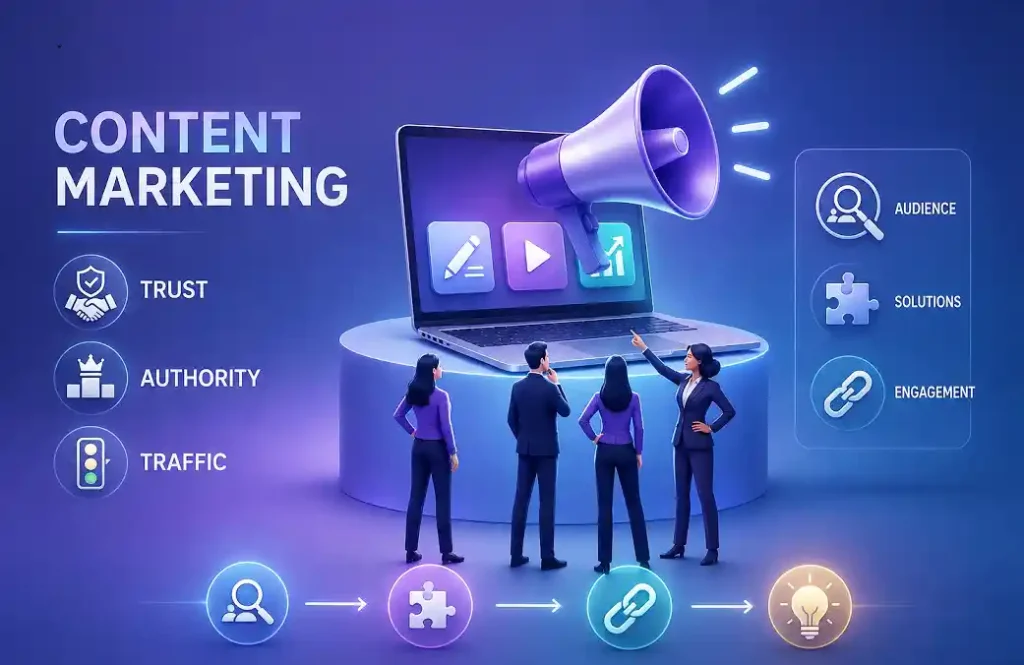
If you have made up your mind to opt for a business with better visibility and reach, content marketing would become the ideal choice. According to the HubSpot State of Marketing Report 2026, blog posts are the third most popular platform for content marketing, just after short-form video (60%) and long-form video (38%). 91% of B2B marketers use content marketing as a pipeline to engage with prospective buyers for driving revenue. Here’s how content marketing would become the voice of B2B business in terms of establishing trust, brand authority, and traffic. Knowing customers’ intent is invaluable.
What they search for, what problems they are facing, and how to keep them engaged are the fundamental tenets for marketing to drive leads and solidify the image of a business brand. Publishing content is not enough, but knowing customer pain points and giving them the needful content is the ultimate motto for content marketing.
How Is B2B Content Marketing Different from B2C?
Before proceeding to know the role of Content Marketing for B2B, it is important to shed light on the existing differences between B2B and B2C. Let’s have a look at the tabular data below.
| Aspect | B2B Content Marketing | B2C Content Marketing |
| Target Audience | Decision-makers & businesses | Individual consumers |
| Primary Goal | Trust building and educating | Drive emotion and quick engagement |
| Key Formats | Webinars, research reports, ebooks, LinkedIn articles | Short videos, user-generated content, memes, quizzes |
| Main Channels | LinkedIn, email newsletters, industry blogs | Instagram, TikTok, YouTube, Pinterest, Facebook |
| Content Style | Professional, in-depth, and data-driven | Entertaining and benefit-focused |
| Content Length | Longer & detailed | Shorter & snackable just seen in videos, reels, stories |
| Tone & Messaging | Logical & ROI-focused | Storytelling, lifestyle-oriented |
| Sales Cycle | Long & complex | Short & fast |
Why Content Marketing is Important for B2B
Several interconnected factors make content marketing essential for B2B businesses in 2026: Let’s have a look at each.
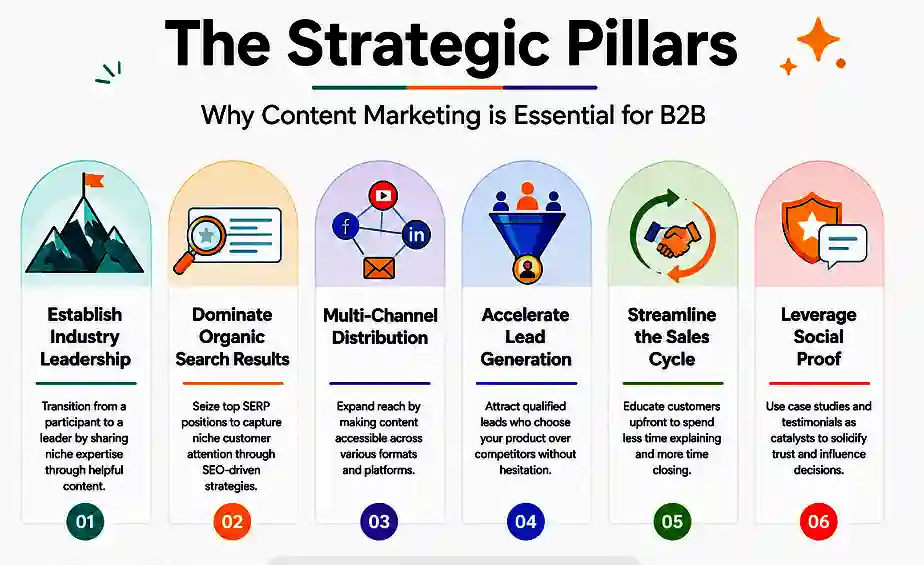
🚀 Builds Authority-Expertise and Thought Leadership
Content marketing helps you create helpful, compelling content through website copy, articles, email newsletters, and blogs to become a leader rather than just a mere participant. Your expertise in the niche makes you credible and strengthens your reputation, helping you make a lasting impact on customers.
Content marketing, meanwhile, is an invaluable strategy for B2B companies, helping them to strengthen authority and expertise build up. Publication of content that consistently delivers higher value generally acquires customers’ trust, forges acquisition of qualified leads, and curtails the sales cycle.
How B2B content drives building authority and expertise
Navigating Real Pain Points: B2B buyers rely on concrete ROI that drives efficiency and operational sustainability. Making compelling content is a gateway to navigate the enterprise difficulties, becoming a solid rationale that you understand their pain points.
Original Research with no fluff: Content that includes proprietary data and industry benchmarks implies first-hand knowledge. Deeply researching the topic is invaluable, and it is important to write content that shows confidence with zero hype. It is a way that proves your solutions are evidence-based, not just mere facts.
🚀 B2B Content Marketing for Lead Generation – Generates Higher Quality Leads
Content marketing is an effective lead-generation channel for B2B companies. According to data from DemandMetric, content marketing is credible enough to generate 3 times more leads than paid search advertising while operating cost is 62% less.
But it’s not just mere volume, it’s all about uncompromised quality.
B2B buyers who find your company while searching for educational content are already familiar with your expertise. They’ve consumed what you are actually thinking about, showing their full-fledged trust in your perspective, and eventually sought you out. Unlike cold outbound leads, this self-qualification process guarantees a higher rate of conversion.
How B2B content drives lead generation
Gated content: High-value resources (whitepapers, research reports, templates) offered in exchange for contact information.
SEO-driven blog content: Articles targeting buyer-intent keywords bring prospects actively researching solutions directly to your website.
Email nurturing sequences: Content delivered through email maintains engagement across the 6-12 month B2B sales cycle, keeping your brand top-of-mind until the prospect is ready to buy.
Webinars: Live educational content that generates registrations, positions your team as subject matter experts, and creates a qualified pipeline from attendees who raise their hands for your topic.
The key differentiator: unlike paid advertising that stops generating leads the moment you stop spending, content marketing compounds in value over time. Well-optimized B2B content can continue generating organic traffic for years. According to HubSpot’s data, it shows that 75% of their monthly blog views come from posts published more than a month ago, with many top-performing posts several years old.
🚀 Improves Organic Search Rankings
With the right strategy of content marketing driven by SEO, you can seize the top position on the Search Engine Result Page (SERP) and grow organically by capturing the attention of niche customers. So if you want to drive more traffic to your site, learn the SEO game to gain greater reach.
Keep your focus on creating content that ranks, outperforms others, and stays visible. On-page optimization is vital, which is led by creating compelling title tag & meta descriptions, inclusion of H1–H3 structure, mention of internal links, and schema markup where relevant. B2B companies with blogs generate 67% more leads per month than those without.
Updates of the older content help bring an improvement for organic search visibility. Leaving content without any updates, on the contrary, renders traffic lost and detrimental to authority retention. Google Search Console, Ahrefs, or SEMrush are invaluable tools helping to identify high-opportunity, lower-competition keywords.
How B2B content drives Organic search visibility
1. Acquiring Topical Authority: Search engines prefer to choose relevant hubs over disconnected pages. Structuring content is gaining the edge through pillar pages and cluster content, which helps Google to easily comprehend deep expertise ot topical authority, guaranteeing the rise of overall domain authority.
2. Securing High-Quality Backlinks: In B2B, creating original, people- first content with data-backed insights generates natural backlinks. The acquisition of links from respected industry is a major facet for ranking signals for search engines and acts as a gateway to gain immediate trust with potential buyers.
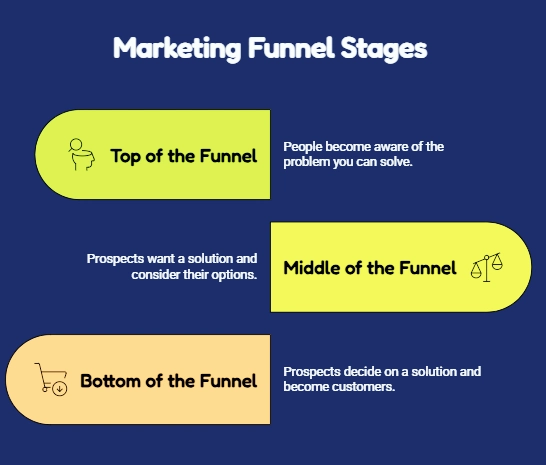
3. Targeting the actual intent of buyers: B2B purchases typically involve fulfilling the expectations of multiple stakeholders. Visibility becomes prominent when your content speaks to the journey of buyers in each stage. It is typically split into three categories: Top-of-Funnel (Awareness), Mid-Funnel (Consideration), and Bottom-of-Funnel (Decision). Check the image below to know about the stages of the marketing funnel.
🚀 Educating customers for better reach
The sales cycle of a B2B business is often long and complex. That’s why educating clients about content marketing is invaluable for setting the backdrop for a smoother sales process. It does not matter whether these are webinars, blog posts, or video-mediated or not; educating customers leads to greater reach.
How B2B content acts as a driving force for educating customers for better reach
Address customers’ pain points: Content marketing is a gateway that helps marketers to directly address customers’ pain points through their content and help to give them solutions or mitigation tactics by visualising their challenges.
Strengthen customer relations: Multiple brands are trying to meet customers’ expectations through their content. B2B content is an authentic approach to connect with customers that guarantees more sales and conversions.
🚀 Delivers Long-Term ROI
If you solidify your content library, the rippling benefits of the marketing initiative give you benefits even after hitting the publish button. A good performing content gives you traffic and maximises the chance to expedite more ROI & authority build-up. B2B content marketing is a simplified solution for establishing business rapport without the investment of ample money.
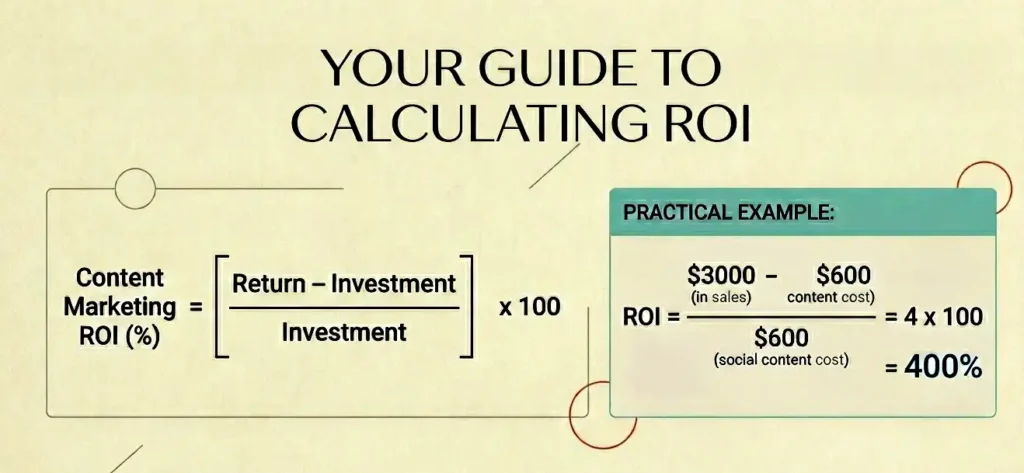
Let’s make me simplify this for you. Supposedly, you spent $ 600 on B2B content creation and promotion. That content ultimately helped you generate $3,000 in sales. Using the formula seen in the above image, you calculate your ROI, which implies that for every $1 you spend on your content, yields $4 back in return. Multiplying by 100 gives you the ROI percentage, which is 400%.
How B2B content drives long-term ROI
| Customer Journey Stage | Content Role | Long-Term ROI Impact |
| Awareness Stage | Educational articles & thought leadership | Builds authority & organic reach |
| Engagement Stage | In-depth guides addressing customers’ pain points | Generates quality leads |
| Conversion Stage | Case studies & decision-making resources | Shortens sales cycles |
| Retention Stage | Ongoing updates & insights | Drives loyalty & repeat business |
🚀 Enables Multi-Channel Distribution
Content marketing is the ultimate gateway to expand your reach and secure a standing in the sales process, making it more sleek and successful. Multiple-channel distribution is a marketing tactic aiming to promote content across distinct platforms for greater reach. The content promotion helps marketers to reach a niche audience, those who consume information. Platforms where the distribution strategy for sharing content works include websites, social media, email, digital communities, video platforms, AI-powered search engines, and podcasts.
How Multi-Channel Distribution works for B2B
| Steps for Multi-Channel Distribution | What It Involves | B2B Benefit |
| Create Pillar Content | based on a guide, report, or webinar, framing of an in-depth core asset | Delivering rich material aiming to be repurposed across many formats for consistent outreach |
| Map Channels & Audience | Buyers’ identification from LinkedIn, email, search/AI, communities & video | Reaches prospects at different stages of buying |
| Track & Optimize | Measurement of engagement level, followed by counting leads, and revenue attribution | Top channels identification and refine strategy for better ROI |
| Adapt & Repurpose | Converting core content into channel-specific formats that may include carousels, emails, short videos, and snippets | messaging consistency |
| Coordinated Publishing | Scheduling and automation for distribution across channels | Time saving & guarantee consistent reach |
🚀 Builds Social Proof and Brand Trust
Sharing the success stories of clients, testimonials, and case studies is a fundamental factor of content marketing that will eventually solidify your trust and positively influence the buying decision-making of sellers. No one ignores the undeniable role of social proof in marketing, as it can help to act as a catalyst for trust building. B2B content marketing is not just about engaging in blogging to gain visibility and working to get clicks.
No, it is actually serving B2B buyers by giving them valuable content to help them to move forward and address their objections and challenges. According to the published content on Myoutreach on June 2, 2026, 97% of B2B customers cited their opinion on the relevance of testimonials and peer recommendations as the most reliable type of content.
How B2B content helps to build social proof and brand trust
In-depth Case Studies: B2B content marketing must shed light on crafting whitepapers and case studies that are detailed without any fluff and generic testimony. For the peers, the actual B2B content addresses a specific business challenge they encounter without any gibberish or false claims of service and product. Nearly 80% of B2B buyers considered referenced case studies as an indispensable part of their buying research.
Sharing of User-Generated Content: During the sharing of content led by key decision makers, regarding thought leadership, on LinkedIn posts, or by circulating the content found in Slack threads, they are bringing the brand advocacy to notice. B2B content marketing is the activity taht is deliberately navigates the influence and educates buyers in their decision process by delivering high-quality content.
Endorsements & Media Mentions by expert: third-party validation is invaluable; industry awards, mentions or expert validation in B2B publications carry the proof that your operation is legitimate and trustworthy.
Real B2B Content Marketing Case Studies
CASE STUDY 1: HubSpot
The reason behind the unprecedented success of HubSpot in B2B content marketing is primarily driven by inbound content marketing. The software company with $1.7 billion in revenue from 2022 to over $2.6 billion in recent years has leveraged free educational content, including tools, academy, and blog content, aiming to attract prospects and eventually convert them into leads.
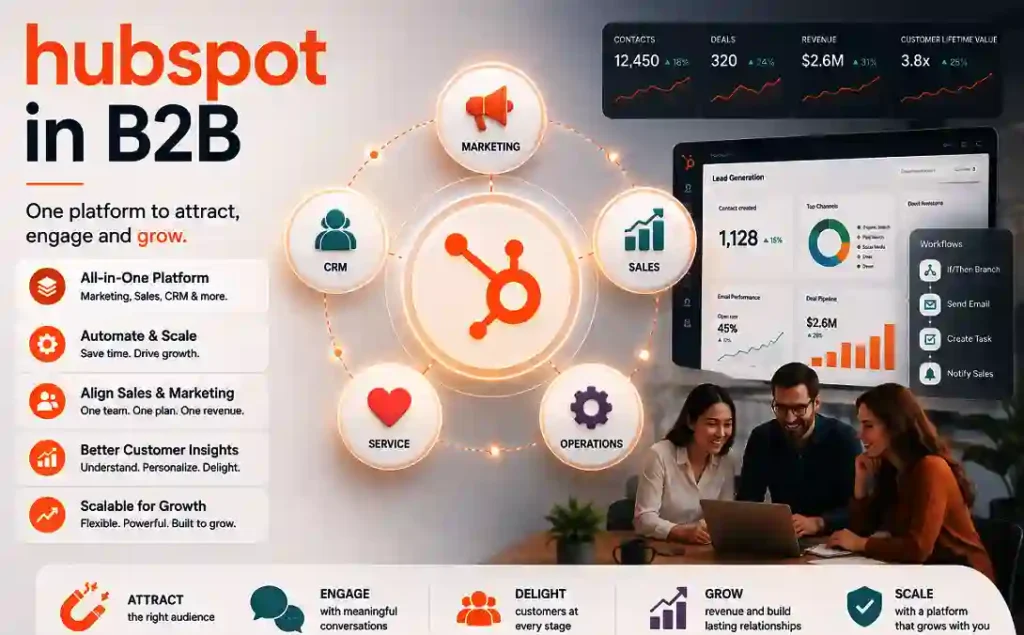
The CRM software company is presently serving 289,000 global customers in 135 countries worldwide. The company created Website Grader, a free tool for evaluating the performance of a website and giving insight for an SEO health check. The free marketing tools have already reached a milestone with reaching 2 million and beyond website URLs for grading.
CASE STUDY 2: Salesforce
Salesforce has a B2B content marketing strategy reflected in their annual “State of Sales” and “State of Marketing” reports. These reports shed light on actionable insights on trends and opportunities in sales and marketing, making them indispensable reference resources.
First, the reports are invaluable as journalists, bloggers, and competitors cite them repeatedly, generating thousands of high-quality backlinks naturally. Second, the consistent annual cadence is helpful for building authority and anticipation, positioning Salesforce as the definitive voice in CRM and cloud computing.
CASE STUDY 3: Mailchimp
Mailchimp has embraced a small business education strategy by empowering SMB owners through delivering guides, tutorials, and case studies. This strategy helps them to gain customer trust and drive revenue. Mailchimp keep their unwavering focus on creating content that helps its customers succeed, not just promoting features. Their commitment has made them become a dominant email platform before being acquired by Intuit for $12 billion.
Lessons Learned from the Most Successful B2B Content Strategies
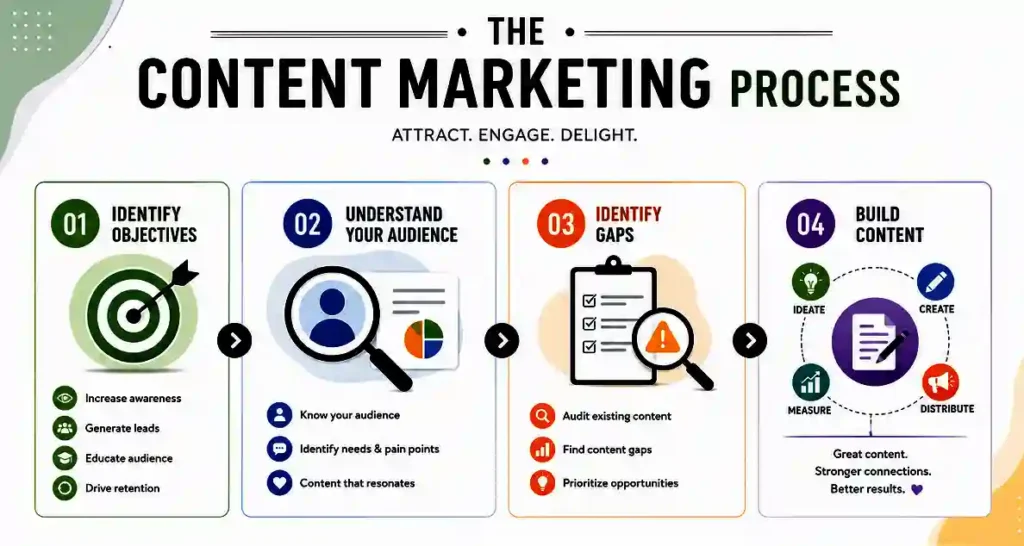
Above, we have already come across Salesforce, Hubspot, and Mailchimp as successful firms for B2B marketing as a case example. One thing is common among the successful players. They all keep focus on genuinely helping their audience, not promoting their product.
| Company | Core Strategy | Key Tactic | Main Lesson Learned | Business Impact |
| HubSpot | Free educational content | Free tools (Website Grader) + Blog & Academy | Give away high-value free tools & education to attract massive inbound traffic and convert to leads | $2.6B+ revenue, 289K customers |
| Salesforce | Thought leadership via research | Annual data-driven reports (State of Sales/Marketing) | Publish original, citable research to earn backlinks, media coverage & industry authority | Strong market leadership position |
| Mailchimp | Customer success education | Practical guides, tutorials & case studies for SMBs | Focus on genuinely helping customers succeed, not just relying upon product promotion | Dominance in the category, $12B acquisition |
Best Practices for B2B Content Marketing
Let’s go through the best practices & the actionable steps that need to be maintained for B2B Content Marketing.
| Best Practice | Actionable steps | Tools | Expected Outcome |
| Market Research | Try to navigate the emotions of target decision-makers, pain points, and key challenges of businesses. Research topics thoroughly as per industry interests. | Semrush, Ahrefs, Google Keyword Planner | Making content that fulfils buyer expectations |
| Keyword Research | Find informational keywords (awareness), comparison keywords (consideration), and solution keywords (decision) Try to understand high-intent B2B keywords having decent volume with lower competition. | Semrush, Ahrefs, Google Keyword Planner | Content aligned to each buyer stage |
| Consistent Cadence | Setting a publishing schedule (weekly or bi-weekly) that is realistic & invaluable. Always try to stick to it. Never forget that consistency builds trust in B2B. | Google Sheets, Notion, Trello, Airtable | Maintaining consistency of the content flow guarantees visible leads across the funnel |
| Visual Elements | Add infographics, charts, and custom visuals. Use LinkedIn, emails, and gated content to foster better engagement. | Canva, Adobe Photoshop, Visme, Piktochart | Ensure better dwell time, subtle engagement, and foster sharability |
| SEO Optimization | Put your target keywords within the content naturally, without any forceful inclusion that makes it not seem like keyword stuffing. Optimise titles, meta descriptions, and headers. Add internal links. Ensure fast & mobile-friendly pages. | Yoast SEO, Rank Math, Google Search Console, PageSpeed Insights | This will ensure a better ranking of your page and guarantee visibility on the Search engine results page (SERP) |
| Quality Over Quantity | Prioritize making in-depth & valuable content. Avoid AI-generated fluff and cross-check every fact to maintain credibility and user trusts. | Grammarly, Surfer SEO, Originality.ai | Keep focus on making Authoritative content that eventually helps to build trust and drives conversions |
Common B2B Content Marketing Mistakes
No documented strategy: Like any type of marketing, it is crucial to have a well-refined content marketing strategy with documentation to become successful.
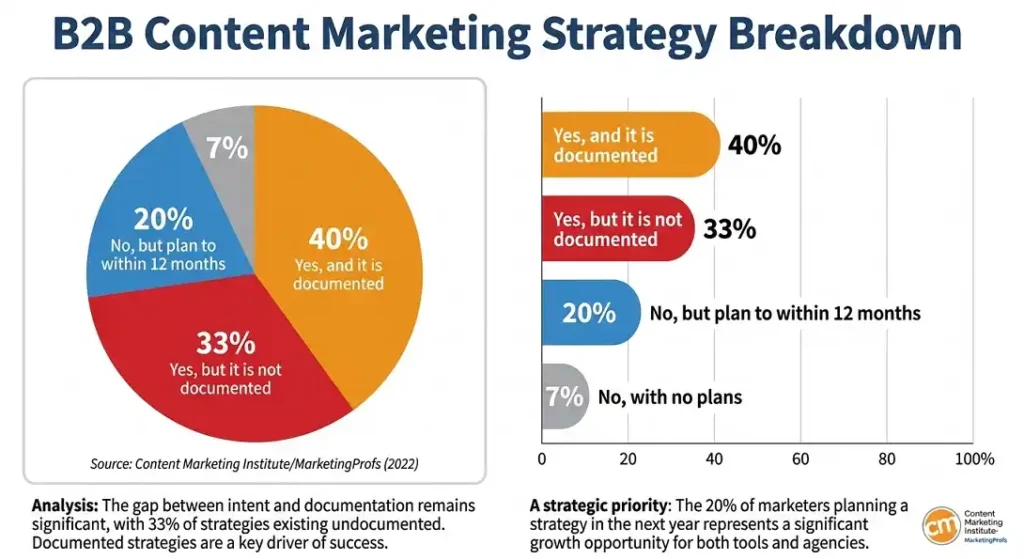
The 13th annual survey of B2B marketers was performed by Content Marketing Institute and Marketing Profs in July 2022. 73% of B2B marketers have a content marketing strategy, where 40% documented and 33% undocumented. Any strategy, no matter whether it is good or bad, is invaluable for success. Even if it is a bad strategy, it still helps to jot down the areas that need improvement.
Strategy tips worth considerable for content marketing
| Strategy tips | Summary |
| Define KPIs | Start by identifying key metrics (views, shares, traffic, CTR, conversions, etc.) and track them consistently. |
| Be Flexible | Regularly review and adjust your strategy when current efforts are not delivering optimal results. |
| Own Your Strategy | Create the strategy yourself. Content marketing companies should only implement (editorial calendar, writing, publishing), not define it. |
| Think Big Picture | Strategy goes beyond just publishing content. Consider overall marketing goals: audience, revenue, profit, and brand positioning. |
Overlooking secondary keywords for content ranking: Using semantic variation is invaluable to get noticed by Google. Search engines like Google rank websites that credibly use semantic variation, not just follow blindfolded matching for exact keywords. Natural inclusion of secondary keywords in H2/H3 subheadings is a signal that search engines understand the expertise of the user over the topic. Ignoring their usage may make your content thin, which is detrimental to securing the domain authority.
If a B2B marketer relies entirely on a single keyword, they are unnaturally repeating it to satisfy only the search requirements. Using semantic variations within content naturally fixes these issues, making the content read well. It sounds more human rather than spammy.
Neglecting highly shareable platform LinkedIn: Neglecting LinkedIn is, above all, a genuine mistake for content marketing, especially seen in B2B. LinkedIn is a professional network that, at present, is becoming a popular platform for decision makers as a centralised hub. Skipping the platform for content sharing may jeopardise the user’s visibility, disconnect them from relevant industry networking and become a deterrent to missing the opportunity for lead generation. 1.3 billion members use LinkedIn for their career, networking, and research purposes. 97% of B2B marketers find LinkedIn a suitable platform for their efforts with content marketing.
Just setting a mere company page is not enough. Maintaining consistency on posting with a hook and scananble bullets helps to establish trust and user engagement. If anyone truly wants to enjoy the rippling benefits of content marketing, consistency is the key that builds meaningful engagement.
Conclusion
In the end, it is worth noting that content marketing for B2B companies is not just a trend but a fundamental concept in which buyers decide what to do. There is no reason to think that B2B buyers are condescending; they are actually self-educated enough and mostly do their purchase research on their own before engaging with a vendor.
If you are unable to provide fruitful content during the initial course of research, someone in the fierce domain would definitely replace you. It is not a short-term campaign, but rather a long-term commitment that prioritizes buyers’ intent and focuses on consistently serving them with resilience and patience. It is not about the budget, but the consistency that helps to gain organic traffic and convert the scroller into a potential buyer.
Frequently asked questions (FAQs)
Q1: How long does it take for B2B content marketing to show results?
Ans: B2B content marketing demands 3-6 months for initial gain of traffic with measurable results, while ranking improvement necessitates the need for 6-12 months of consistency while publishing content and gaining leads.
Q2: What type of content works best for B2B marketing?
Ans: In-depth, educational content that comes up with case studies, webinars, whitepapers, and how-to guides works best for B2B marketing.
Q3: What metrics should B2B marketers track?
Ans: Marketing-Sourced Revenue, Customer Lifetime Value (CLV), and Customer Acquisition Cost (CAC) are metrics tracked by B2B marketers.
Q4: What’s the difference between B2B content marketing and B2B advertising?
Ans: B2B content marketing sheds light on framing valuable, educational content over time to acquire trust, while B2B advertising, on the contrary, uses paid promotions for immediate gain for visibility and lead generation.
Q5: How often should a B2B company publish content?
Ans: There is no magic number that exemplifies the publishing frequency of content. A B2B company should publish 2–4 blog articles monthly, without any quality compromise for optimal results.
Q6: Does B2B content marketing work for small businesses?
Ans: Yes, certainly, B2B content marketing works for small businesses as it has a strong ROI, producing credibility without any massive advertising budget.
Q7:How much should B2B companies spend on marketing?
Ans: The allocation of money for B2B companies in marketing typically ranges between 8% and 11%.
