

Gaining complete mastery of marketing is not an easy task. It is often seen in marketing professionals that they juggle with framing the appropriate marketing strategy for better growth and consolidation. Meanwhile, it somehow makes them feel intimidated by budgetary constraints, burgeoning demand, and the need for making decisions.
No one can ignore the important determinant of marketing, which is the customer. Unlike B2C marketing, which involves businesses geared towards directly to customers, the B2B business sheds light on marketing their intended product or service to other businesses.
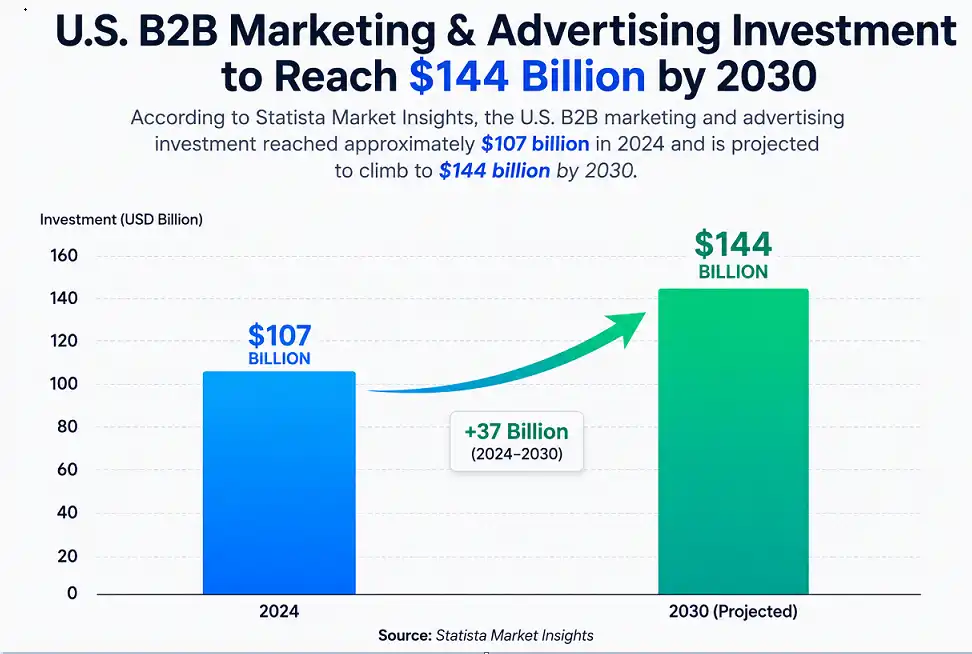
According to data from Statista, in 2024, the B2B marketing investment has skyrocketed to 107 billion U.S. dollars, projected to reach 144 billion by 2030. Business-to-business marketing won’t sell products directly to individual customers, but rather prioritizes selling the service or product to other businesses.
Knowing the types of B2B marketing is invaluable as it gives a high-stakes analysis of corporate buyer behaviour, what they are looking for, and, to be precise, their intent. In this article, you’ll learn 4 types of B2B marketing, the core of B2B marketing, and much more. Go through it to discover more.
What is B2B marketing?
Business-to-business marketing, abbreviated as B2B marketing, is a type of marketing that focuses on a target buyer group instead of individual customers. It generally involves a business informing another business or decision makers of a product or service rather than communicating directly with end customers.
Let’s simplify it for you. Supposedly, a business necessitates the requirement for a software to manage the company’s payroll. What does it do? Simply, it will market the product on behalf of the organisation, aiming to streamline the process for better compensation, is not so? This is why the concept of B2B marketing is solidifying its position in the market. Every virtual business in the present time is dependent upon B2B marketing for operating its business facet, whether it is for products or services.
The Core of B2B Marketing
The core of B2B marketing is simple, straight, and easy to navigate. B2B marketing is a process to connect with the right buyers with the proper content without any delay, right on time. The marketers need to have an understanding of how the orchestration for the buying journey needs to be executed to expedite the pipeline with minimal wasted effort for unlocking the revenue gain.
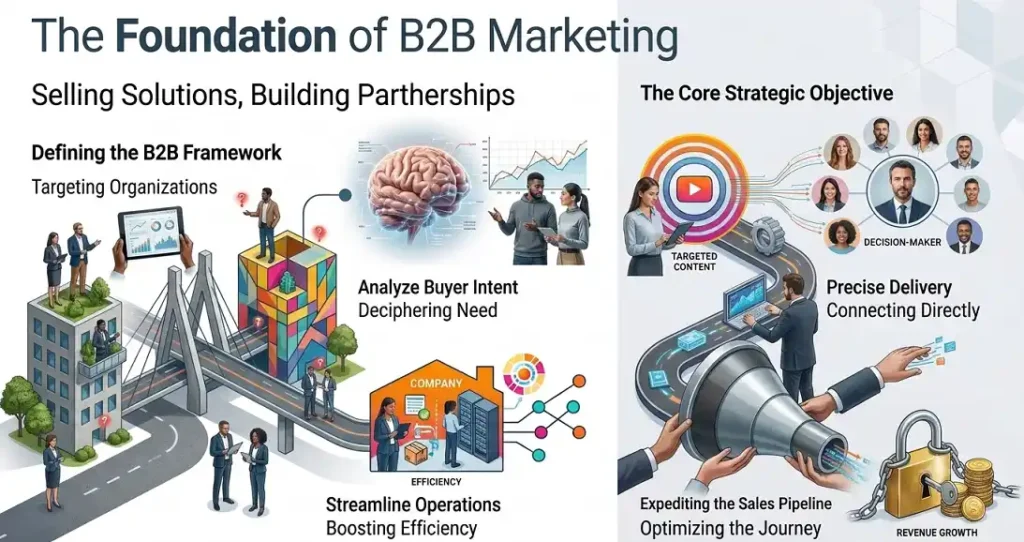
Unlike B2C marketing, which is driven by a customer’s fleeting impulse to purchase, B2B marketing is a different game that demands influencing the rational decision makers to make out their true need and serve accordingly.
How B2B Marketing works, key objectives, and main channels
| Understanding the stage of the Buyer Journey | Key Objective | Marketing Approach | Best Content Examples | Main Channels |
| Problem Awareness | It helps businesses to address the areas of issues and ways for mitigation | Educate them to raise their awareness | Blog posts, Industry reports, Webinars | LinkedIn, SEO, Paid ads |
| Decision | Close the deal | Supporting the approval that is finally executed, done, and dusted | ROI calculators, Proposals, Testimonials | Direct sales, Personalized emails |
| Research | Researching help to position the intended solution business is craving for | Provide information that is valuable and authentic | Guides, Whitepapers, Comparison sheets | Email, Search, Content hubs |
| Evaluation | Differentiate to make out how to establish trust | Detailed proof | Case studies, Demos, Technical docs | Email nurturing, Events, Webinars |
| Adoption & Growth | Drive for acquiring more loyalty & expansion for better positioning and consolidation | Deliver ongoing value | Onboarding resources, Success stories | Customer portals, Newsletters |
What are the 4 types of B2B Marketing
THE 4 TYPES OF B2B MARKETING: 1. Direct Sales Marketing 2. Digital Marketing 3. Content Marketing 4. Relationship Marketing
B2B Direct Sales Marketing
Direct sales marketing in B2B is an outreach initiative, one-to-one, aiming to connect with corporate decision makers in order to form a direct communication channel. Unlike indirect marketing, Direct Sales Marketing sheds light on personalized interaction with the target buyer group by cutting the unnecessary clutter or intermediations.
Social media, digital ads, SMS, and email marketing come under direct sales marketing. Meanwhile, it involves segmenting the decision makers based on certain criteria like job roles, buying behaviour, pain points, and company size. Let’s make me simplify this for you.
Supposedly, a marketing consultancy firm is trying to outreach service to a technology company & its executive by offering a useful strategy that uplifts their digital presence. Here, no need for any intermediaries, just personalized communication between the business and decision makers. The rippling benefits of direct sales marketing on the business are multifaceted. It assists businesses by rendering targeted reach, establishing personalized communication, confirming engagement, and driving measurable results.
B2B Digital Marketing
Every business, no matter whether it is operating under a B2B or a B2C environment, needs to have a digital presence in the market. Keeping a website, SEO, paid ads, outreach initiative, and other online channels makes the site feel like it’s working and alive. This is why digital marketing is becoming a masterstroke strategy for B2B marketing to make a site appear as easily discoverable online.
Website optimization with people-first and informative content that meets clients’ expectations is gaining more visibility on the Search Engine Results Page (SERP). Being digital marketers or decision makers in B2B business, knowing the tactics to secure a spot on SERP is fundamental for enhancing reach and authority.
It not only means to gain top on Google search but also to gain recommendations from perplexity, ChatGPT, and Gemini as a rich snippet that the content is trustworthy and reliable. Knowing the on-page and off-page SEO is fundamental to building trust and authority for the site that propels corporate decision makers to search for information from the target website. Let’s have a look at each below in a table to make them easily understandable for how they help to rank your content.
| Areas to keep focus on | On-Page SEO Tweaks | Off-Page SEO Tweaks | B2B Benefit |
| Content & Keywords | Create in-depth content with long-tail keywords by naturally placing them in titles and headings | Earn backlinks through guest posts and data reports on industry sites | Builds thought leadership and attracts high-intent B2B buyers |
| Technical Optimization | Fast loading, mobile-friendly, schema markup, internal linking | Build brand mentions on authoritative platforms like LinkedIn and Clutch | Improves user experience and crawlability |
| Link Building & PR | Internal linking to pillar pages | High-quality backlinks via digital PR | Boosts domain authority and earns referral traffic from B2B sources |
| Title, Meta & UX | Compelling title tags and meta descriptions with CTAs | Sharing on LinkedIn for content advocacy and community engagement | Higher click-through rates |
| Visuals & Authority | Resizing of images with descriptive alt text for optimization | Get featured in industry publications | Strengthens social proof |
B2B Content Marketing
B2B content marketing is the holistic process of distributing and creating content for other businesses, aiming to convert the scrollers into potential buyers. B2B content marketing serves the audience the rightful things they are anticipating and gives them helpful content to transform them from visitors to buyers.
To know more about B2B Content marketing, read the blog Why Content Marketing is Important for B2B to gauge your better understanding of it. Content marketing is invaluable for B2B as they help to make content valued by clients. It will indeed lead to generated shares on social media, helping to earn backlinks that derive rippling benefits from SEO and support the build-up of industry authority.
Content Marketing is nothing but a channel of inbound marketing that converts visitors into customers and helps to gain a strategic edge over rivals in the market. There is a change in the process of how B2B buyers search in 2026 for their B2B marketing needs.
They prioritize Answer Engine Optimization (AEO) and consider AI as the Operating Layer for their business decision-making. Meanwhile, they are giving emphasis on proof Content that can beat fluff or unnecessary jargon. According to information from Search Engine Journal, 72% B2B buyers, during their research, consider an AI overview, and 90% end up clicking on it for fact-checking purposes. A blog is an important instrument worth considering for B2B content marketing, helping a brand to improve SEO rank, educate the audience, and confirm lead generation.
B2B Relationship Marketing
B2B relationship marketing is nothing but a type of B2B marketing activity aiming to establish mutually beneficial partnerships with another business without pursuing full-fledged interest in a single transaction. This type of marketing aims to reassure the gains for customer loyalty until they become an integral part of the brand.
Rationale behind choosing B2B Relationship Marketing
| Benefits of Relationship Marketing | Rationale behind choosing | B2B Impact |
| 1. Increment of LTV (Lifetime Value) over time | Prioritize long-term customer relationships over one-off transactions. Foster recurring purchases and deeper engagement. | Loyal customers generate higher recurring revenue for B2B. |
| Customer Communication Improvement | All marketing, sales, and customer service teams align around delivering a consistent customer experience. | Strengthens the company-customer bond and ensures every touchpoint supports loyalty. |
| Reduce spending on Marketing & Advertising | Positive experiences of customers influence potential buyers through word-of-mouth | Minimize Customer Acquisition Cost (CAC) by reducing reliance on paid campaigns |
Conclusion
The key to B2B marketing is not just publishing blogs, making insightful webinars and crafting compelling posts on LinkedIn to attract visitors. While making content, it must address the pain points of the target audience and give them insightful data that builds confidence and credibility. No matter whether you are a novice or an expert professional, knowing every tenet of the B2B marketing strategy is fundamental to staying ahead and gaining success in the long run.
Frequently asked questions
1. What are common B2B marketing mistakes?
Ans: Not having an idea of the target audience, making the salesfy message poorly aligned, and wasteful spending of the budget without a defined vision are common B2B marketing mistakes.
2. How does B2B marketing differ from B2C?
Ans: The business-to-business (B2B) marketing focuses on decision-makers & businesses as the target audience, while consumers are the main consideration to meet their needs in the case of business-to-consumer (B2C) marketing.
3. What are the essential skills needed to embark on B2B marketing success?
Ans: Essential skills needed to embark on B2B marketing success are analytical sharpness, strategic outlook, and interpersonal skills that help to understand the logic over emotions.
