

Are you someone who struggles to gauge B2B content marketing ROI? You are not alone in finding it arduous. Knowing the metrics and incorporating them with ROI measurement is becoming a survival skill, to be precise, an absolute necessity. In the article, I will shed light on key metrics for measuring content marketing ROI and also why measuring them is becoming an absolute necessity in 2026.
Table of Contents
What is Content Marketing ROI?
One thing is common when you search for Content Marketing ROI on your search engine. You can definitely find the formula on almost every website showing Content Marketing ROI % = ([Return – Investment] / Investment) x 100. But have you questioned yourself about what to do next? Knowing the formula is not enough. Let’s simplify.
Supposedly, being a B2B professional, you are posting a blog. Does it attract leads, or does your content convert viewers into buyers? Without any definite answer to the question, you may get lost in the dark and not be able to grow with purpose.
Why Measuring B2B Content ROI Matters in 2026
The B2B Content ROI denotes the actual return coming from marketing efforts over the marketing cost incurred for it. Unlike the B2C marketing, the B2B marketing has a considerably higher sales cycle and mostly witnesses a complex journey for the buyer. Then what does it mean?
It actually implies one has to measure ROI for a considerably longer time frame, while at the same time, needs to watch multiple touchpoints during the entire marketing funnel. To do so, it is a prerequisite to have the right metrics or strategy in hand to never face futility with B2B Content. In 2026, buyers know how to do independent research using AI that is why the traditional “click-and-lead” metric no longer works.
The calculation of ROI is measured by the use of the specific channel you use. Consider the example to know it better. For example, suppose your Google Adwords gives you an ROI value of 100%. On the other hand, you earned 150% ROI from LinkedIn advertisements. It means the channel LinkedIn is 50% more efficient to give you 50% more ROI. Now the question is how to measure it, or are there any metrics that help to gauge them? Let’s have a look at some Key metrics for measuring content marketing ROI in the next part of the article.
Key Metrics for Measuring Content Marketing ROI
TRAFFIC METRICS
Traffic metrics are a leading indicator that helps to gauge user behaviour, volume and the users’ sources who are visiting a website. It acts as a signal that exemplifies visibility and user interest for a website. It’s all about measuring the user engagement on the site and the time they stay on the page.
Organic sessions (Google Analytics)
If you are a B2B professional and are willing to measure brand visibility and user engagement on your site, the organic session gives you details for unique visitors who reach your site organically without being lured by any paid advertising. A steady rise in the organic sessions signals that the content is user intent-focused, which will minimise dependence on the paid ads.
For example, Google Analytics 4 reports are helping to determine organic traffic. Keep your eye on the pages and screens report of Google Analytics under the engagement section to know which pages generate traffic on selected timeframes and which fail to do so. The Google Search Console report will give you info on the keywords your site ranks for.
Keyword rankings (Semrush, Ahrefs)
To determine the topical authority and relevance of the content, the keyword ranking tool helps to make out the subtle position the website holds for the search query in the search engine result page (SERP). If you notice a higher rank, it generally denotes higher traffic that increases the likelihood of better conversion for the transactional or commercial keyword.
Semrush and Ahrefs are visibility indicators that help to measure the subtle position for specific queries in SERPs. Semrush and Ahrefs are industry-standard tools to measure keyword ranks, assisting in the navigation of brand visibility, gap fixation, and giving unwavering support to grow across Google and AI search. They do not directly help to track the sales funnel for B2B, but help to estimate the traffic value for optimization of inbound marketing.
Backlinks earned (domain authority signal)
Backlinks are an important signal that acts as a digital endorsement proving the content is useful, authoritative, and high-quality. The search engines consider the content as helpful and high quality when backlinks are earned from reputable sites. In the B2B ecosystem, the backlinks are tied to measuring ROI by promising immediate revenue and also compounding the growth for long terms result. There are myriad ways to earn backlinks. Let’s have a look at the table below to make it easy to understand.
| Ways to earn backlinks | Brief Description |
| Create Premium Content | Make high-quality how-tos, guides, and lists |
| Skyscraper Content | Create better, more complete versions of top content |
| Partnerships | Reach out to relevant sites for collaborations |
| Forums & Interviews | Participate in Quora, forums, or interviews |
| Competitor Analysis | Check competitors’ backlinks and replicate |
| Infographics | Design shareable visuals for others to embed |
| Guest Blogging | Write articles for other sites with your link |
| Testimonials | Write reviews for relevant tools & products |
| Broken Link Building | Find dead links and suggest your content |
ENGAGEMENT METRICS
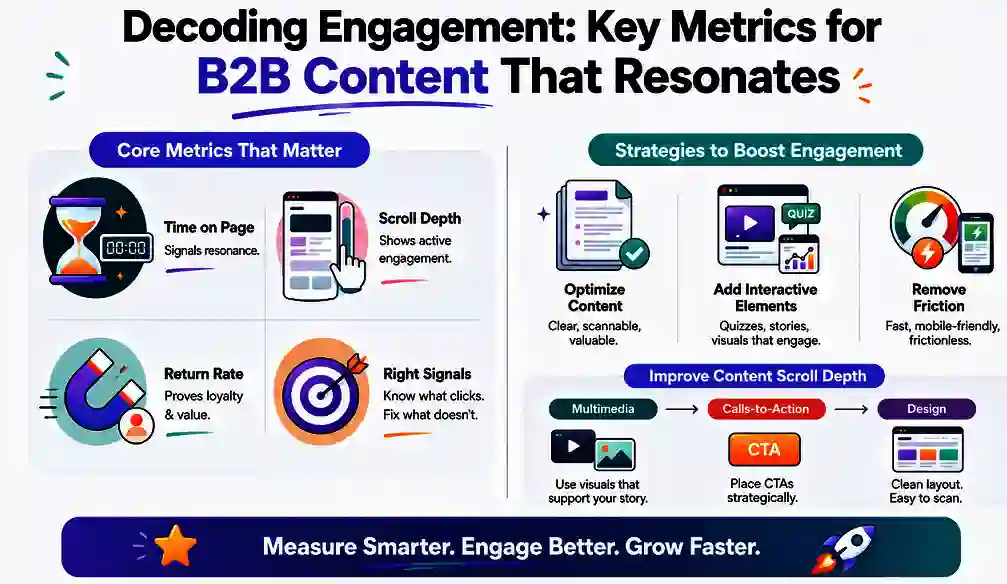
Engagement metrics are an important & relevant quantitative data point helping to resonate with customers’ interaction with the content. In B2B marketing, they are instrumental in keeping track of the buying journey and helping with content resonance identification. It reveals how much time visitors spend on the site, pages explored by visitors, and the times they lose interest.
Time on page (content resonance)
Time on page refers to the time frame a user spends on a page before going away from it. In terms of relevance and content attention, this plays an invaluable role to know is the content genuinely deserves attention from viewers or not. Engagement on the surface level implies poor page experience and signals a mismatch for the targeted audience.
Time on the page refers to information about whether visitors are truly engaged with the page or just inflating the count of visits. A myriad of ways help to improve the time on page. Making a long form of content gives visitors a reason to stay on a page.
Outdated data, thin content with gibberish information acts as a push, making the visitors leave the page quickly. Font size, visual hierarchy, and colour contrast come under page layout. Any frustrating experience on the page due to a page layout issue makes visitors quickly leave the page. Technical issues can lead to slow load times and poor optimisation in mobile devices act as a deterrent to make content difficult to read.
Scroll depth (content quality)
Scroll depth tells the B2B professional whether the user is really reading the information or just keeping the tab open by doing nothing on the page. The more high-quality content you dish out to the audience, the more it will lead to better page engagement. It is a sharp indicator that shows whether the user is actively consuming the content or just glancing at it. Let me simplify this for you.
Ways to improve scroll depth
Let’s have a look at the strategies that would help you to improve scroll depth for your B2B content.
| Key parameter | Strategies to Improve Scroll Depth |
| Content Structure | Use logical flow, clear headings/subheadings, short paragraphs, bullet points, and whitespace. |
| Multimedia & Visuals | Add relevant images, videos and infographics throughout to maintain interest. |
| Calls-to-Action (CTAs) | Place CTAs strategically throughout to guide users after valuable sections. |
| Interactive Elements | Include quizzes, infographics, storytelling, or narrative arcs to boost interaction. |
| Design & Usability | Intuitive layout, fast load times, and full mobile responsiveness need to be shed light on, and it is also crucial to avoid clutter. |
Return visitor rate (audience loyalty)
Return visitors imply visitors who come again to the site they visited before. If the rate of return visitors is high, it is a steadfast indication that signals content loyalty, brand recall and a holistic buyer journey. It shows that the site provides value that brings visitors back to the site. Unlike the visitors visiting the site for the first time, the return visitors imply audience loyalty who are showing their genuine interest in the site.
Email open & click rates (newsletter quality)
Email open & click rates are a fundamental metric for B2B marketing that transforms the lead into a pipeline conversion, driving the pull from the newsletter. The % of users who open the newsletter refers to the good health of the listing.
LEAD METRICS
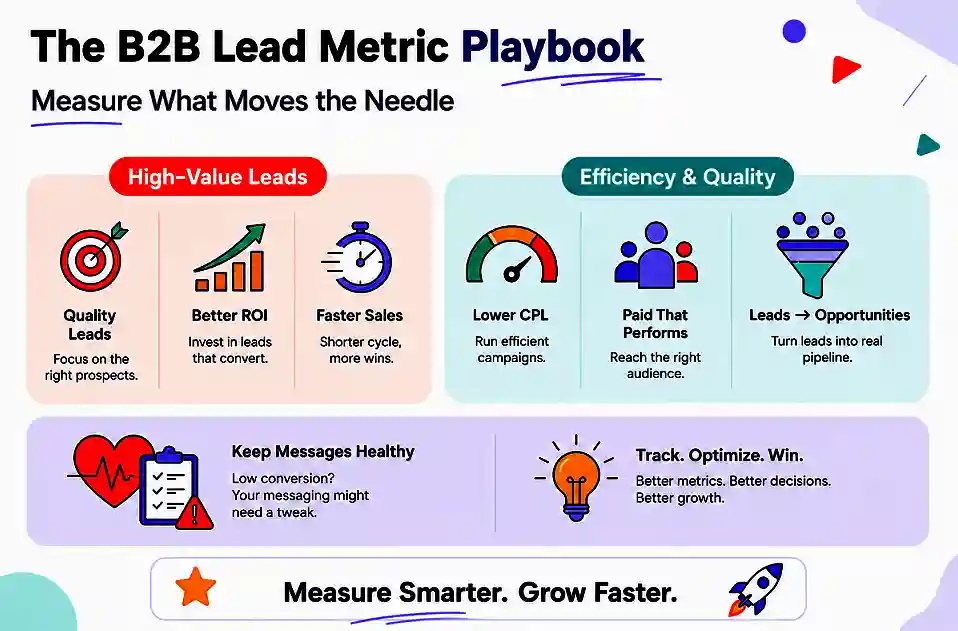
B2B lead metrics are important facets for driving the ROI for content marketing, with their quantitative data points, credible enough to measure the acquisition and conversion of buyers. Unlike the money you pay for B2B, the lead metric gives an overview of lead generation efforts that guarantee revenue-making.
Content-influenced leads (CRM attribution)
Content-influenced leads shed light on the volume of leads that are credible enough to interact with your content during the buying journey. Actually, they shed light on prospective buyers who keep themself engaged with the material before going to make any purchase deal. In B2B marketing, they are helping to speed up the sales cycle, reducing the time needed to be spent on educating the team by sales professionals to explain the fundamental concept.
MQL (Marketing Qualified Leads) from content
Market Qualified Leads exemplify the prospect types showing their real interest and are capable of becoming a guaranteed sales conversion. A strong rate of conversion denotes that the content is credible enough to meet the buyer’s intent over the course of the buyer’s journey.
Why go for Marketing Qualified Leads and their benefits
| Benefit | Brief description |
| Higher Conversion Rates | Focuses on lead generation with genuine interest, ensuring higher conversion rates compared to cold leads. |
| Improved ROI | Resources are allocated to high-potential leads, maximizing sales investments. |
| Quality Over Quantity | Builds longer customer relationships and stronger brand advocacy. |
| Shortened Sales Cycle | MQLs are allowing sales teams to skip early nurturing and close deals faster. |
Cost per lead vs paid channels
Cost per lead helps to gauge the marketing campaigns that are capable of generating the best leads at a considerably lower cost of investment. While less money is invested in high-quality lead generation, it guarantees better conversion with more revenue.
Simply putting this together, knowing the cost per lead helps to spend money wisely and helps to generate better results. Paid channels, on the other hand, are platforms of advertising (like Google Ads or Meta) demanding the need for paying to reach the target group.
Lead-to-opportunity rate
Lead-to-opportunity rates measure the volume of leads that can be transformed into opportunities. It is the gateway that helps to understand the pulling capacity of the process to generate high-quality leads. If somehow the campaign fails to ensure the lead conversion, despite making tons of leads, it is a steadfast indication that something is wrong with it, or it needs some tweaking or moderation with messaging.
There is also the possibility of something wrong happening with understanding the audience’s intent and delivering value. What does it reveal? Despite making an ample number of leads, failing to convert them into conversations seems futile. Meanwhile, it is an indication that the lead generation endeavour is losing ground in transforming the lead into a thriving opportunity.
REVENUE METRICS
Customer Lifetime Value of content-sourced customers
Customer lifetime value is the projected gross revenue from a business, or the amount expected based on the profile of a single customer over the entire relationship timeline. The customer lifetime value provides more granular insight that brings success for B2B content marketing. Optimising the metrics for the long term ensures greater profitability and reduces marketing-related waste of money.
Let’s have a look at an example to make it easier to understand. Supposedly, a B2B SaaS company sells product management software at $3500 per year on a subscription basis. A company agreed to a settlement for 8 years. Hence, the firm negotiated for an 8-year tenure, which makes a spending of $3500*8= $28000. On the other hand, suppose a business is not satisfied with the product and abandons the brand immediately after 1 year, the lifetime value of the customer drastically falls.
Content ROI = (Revenue from content – Cost) / Cost × 100
Content ROI is measured by dividing the difference in revenue from content by the cost of content creation. Supposedly, you have spent a figure of $200,000 for content that will return you a whopping figure of $600,000 in the pipeline, then your ROI for it would be 2x.
Realistic Timeline for Better Content ROI
The ROI from B2B content is generally a compounding process, not something that just happens overnight. Meanwhile, to achieve a better content ROI, it demands some time from gaining early traction to attract an audience and fetch more traffic by maintaining consistent publishing.
Let’s have a look at the tabular data below to know the expected outcome during the course of a timeline. Most B2B companies witness the achievement of meaningful ROI from content marketing within 6-12 months of consistent publishing.
| Time Period | Key Activities & Progress | Expected Outcomes |
| Months 1–3 | Heavy focus on content creation and publishing | Initial setup complete, minimal traffic |
| Months 3–6 | Content starts gaining visibility | Early organic rankings, first leads appear |
| Months 6–12 | Consistent publishing + optimization | Compounding traffic growth, steady lead flow |
| Months 12–24 | Content library matures and compounds | Content becomes a primary lead generation channel |
Conclusion
In a nutshell, there is no silver bullet that guarantees ROI from B2B marketing. Rather, there are tried-and-true strategies that act as an instrument to deliver results consistently. Knowing the metrics is quintessential to measuring the ROI for B2B content marketing.
